730 F26 Week 8: 10/27/26. Towards melodic universals
- Transcriptions are not data, but phonological analysis.
The AM approach has proved fruitful to account for intonation in a variety of typologically diverse languages (e.g., Grice, 1995; Gussenhoven, 2012; Hayes & Lahiri, 1991; Hualde, 2002; Jun, 2005a, 2014a; Pierrehumbert & Beckman, 1988) and to compare languages and language varieties on the basis of shared assumptions and methods (Frota & Prieto, 2015a; Prieto & Roseano, 2010). Within this approach, the transcription of intonation in a given language is usually taken to reflect “the understanding of the intonational and prosodic grammar of the language”, grounded “on rigorous analyses of the intonational phonology” (Beckman et al., 2005, p. 12). (Frota, 2016, p. 2)
- Frota lists the following (directly quoted below) as "dimensions of prosodic variation" for intonation (p. 14)...to what extent do these come out in transcriptions?
- the properties of word prosody (presence/absence of stress and lexical pitch)
- the properties of prosodic structure (the kinds of prosodic domains and prominence relations, important to establish the relevant heads and/or edges)
- the types of distinctive pitch events (pitch accents and edge tones, whether alignment is distinctive, whether scaling is paradigmatically contrastive)
- the prosodic domain for the distribution of pitch events (which determines a more dense or sparse distribution)
- the constraints on tune realization (tonal string adjustments, like truncation and compression, and segmental string adjustments, like lengthening and epenthesis)
Tonotactic grammars
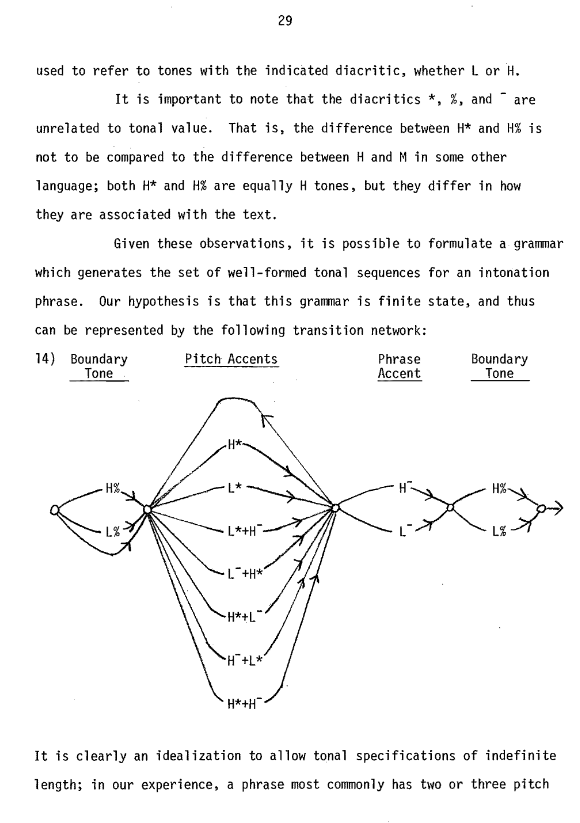
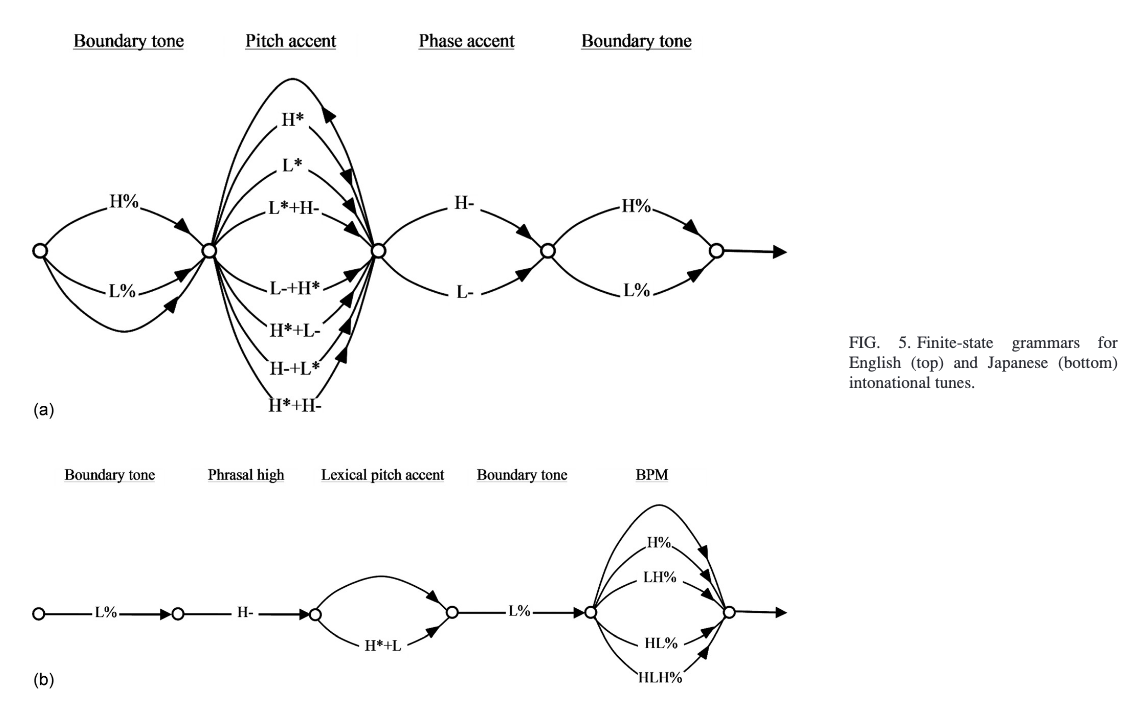
- Igarashi et al. (2013) finite state acceptors for English based on Pierrehumbert (1980) and for Tokyo Japanese:
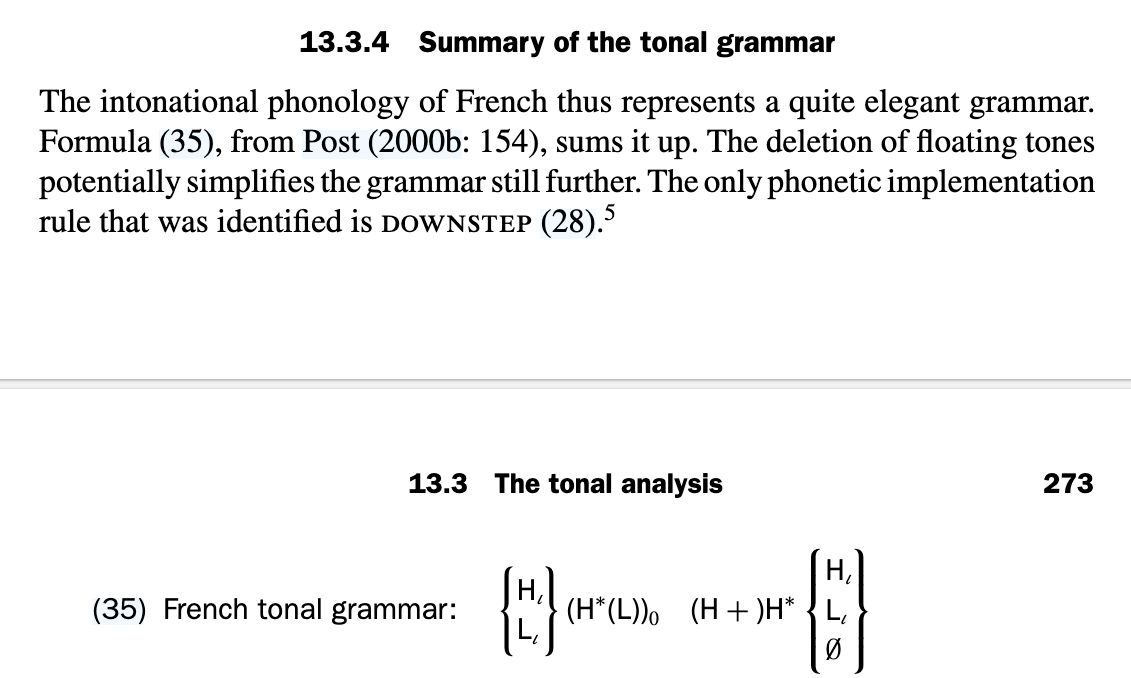
- Gussenhoven (2004) regular expression (finite state grammar) for French intonation:
Challenges
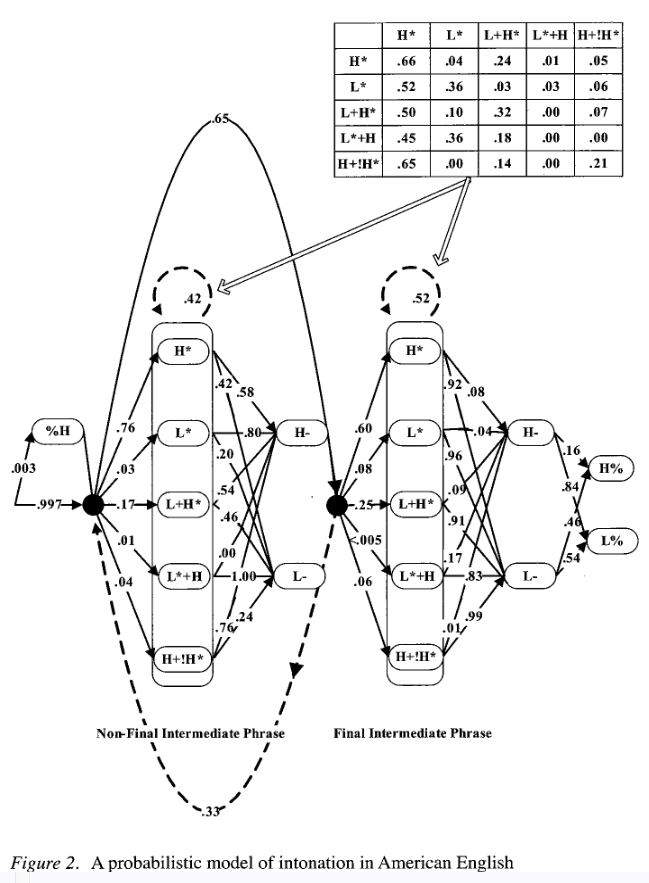
- Pierrehumbert (1980)'s note about sequences of arbitrary finite length: are there no contextual dependencies beyond the preceding tone? See Dainora (2001, 2006)'s weighted finite state acceptor, estimated from the MAE ToBi-transcribed porition of the Boston News Radio Corpus. (What would the FSAs look like for one of the Romance languages we looked at from Frota and Prieto (2015)?)
- Weights/probabilities: do these matter? Recall our discussion of frequencies of Bengali AP melodies, see Yu et al. (2026).
Figure 5. Subsection of B-ToBI FSA generating licit AP sequences for APs that are neither ip- nor IP-final: (a) only the most common sequence, “L* Ha”; (b) all possible sequences (but see Note 9), irrespective of their expected frequency; (c) all possible sequences, with estimated conditional probabilities of each tonal choice computed from the non-IDS corpus. Since we are looking at only AP melodies, we define the final state as the state reached after generating the AP boundary tone.
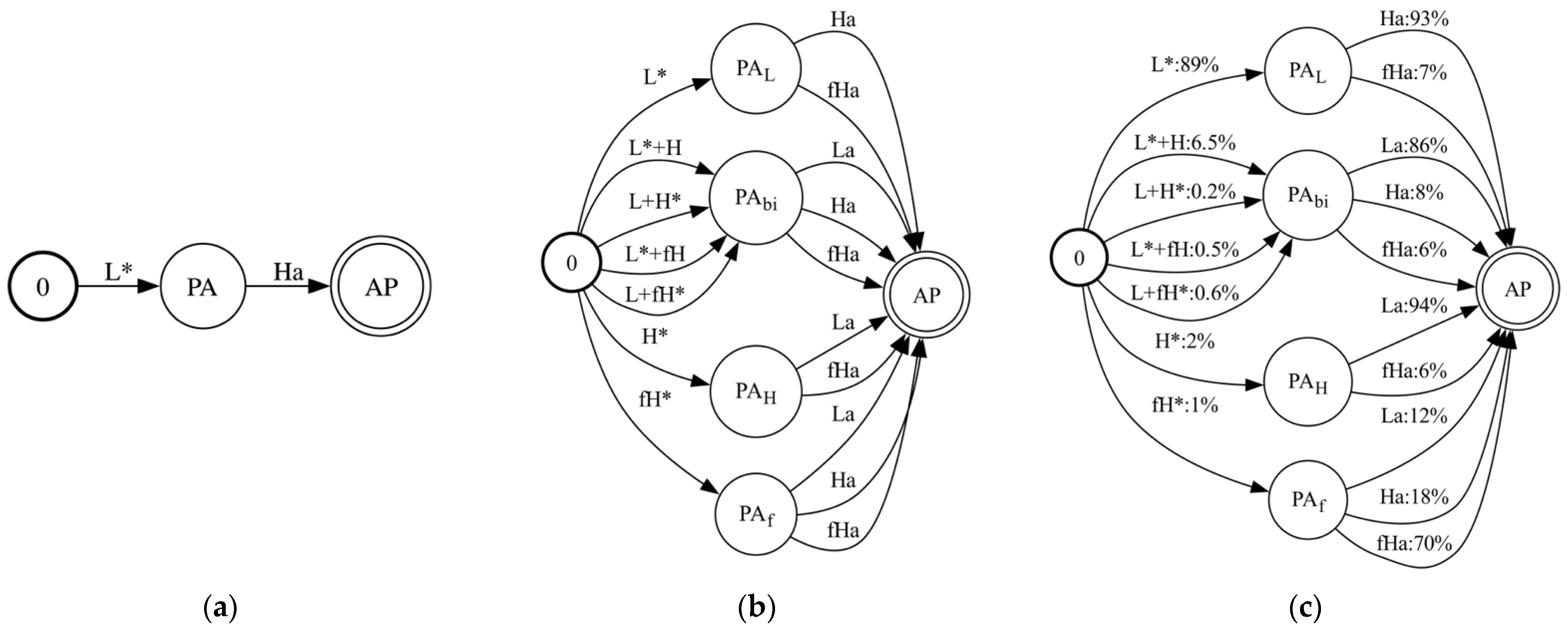
- Where is OCP encoded in the Bengali grammar? Overriding?
- Does it matter what the source of the tone is, e.g., morphology, lexicon, phonological (boundary), phonological (head), etc.? (recall when we discussed Hyman vs.~ Beckman and Venditti's views about typology)
- What about tunes that may need to be described in a more abstract tune template + association patterns that may depend on utterance length? (Torreira and Grice 2018, last week)
- Other challenges?
Intonational transcription and melodic universals
- Note one issue is that the tonotactic restrictions are all expressed in terms of transcribed tones. To what degree can we adequately consider cross-linguistic similarities and differences across transcriptions? (And are there alternatives?)
Frota (2016)
Importantly, both within and across languages, surface pitch similarities may be apparent and accidental.” (Frota, 2016, p. 2)
- within language: allophonic variants may look similar in certain contexts
- across languages: same contours, but different grammatical sources
Similar phonetic realization, different phonological categories: narrow focus in European Portuguese (EP) vs. Catalan
Based on evidence from production and perception, both within and across languages, I argued for a distinction between the EP and the Catalan narrow focus contours supporting the appropriateness of the H*+L and the L+H* analysis, a distinction akin to that found between EP and Spanish, or between certain varieties of Italian. In this case, surface pitch similarities are only apparent, and what may look the same contour phonetically effectively corresponds to accidentally similar realizations of different categories. In other words, languages can differ in which part of the rise-fall pitch contour is phonologically relevant.” (Frota, 2016, p. 7)
Narrow focus peaks in European Portuguese (EP) and some Italian varieties analyzed as H*+L fall vs. Catalan/Spanish/other Italian varieties L+H* rise even though they can look quite similar
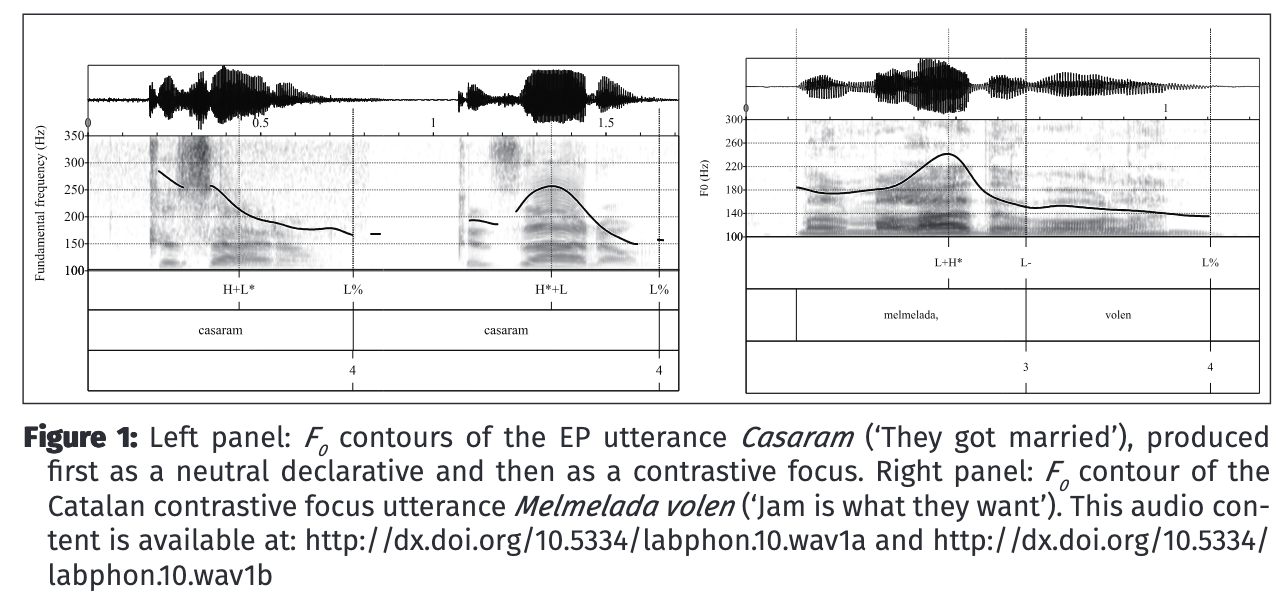
But differ systematically in production:
- EP: larger, earlier fall, not necessarily a clear preceding low target
- Catalan: later peak towards end of accented syllable, clear preceding low target that rises into peak
Perception experiment: asked EP and Cat/Spanish listeners whether rise or fall more salient.
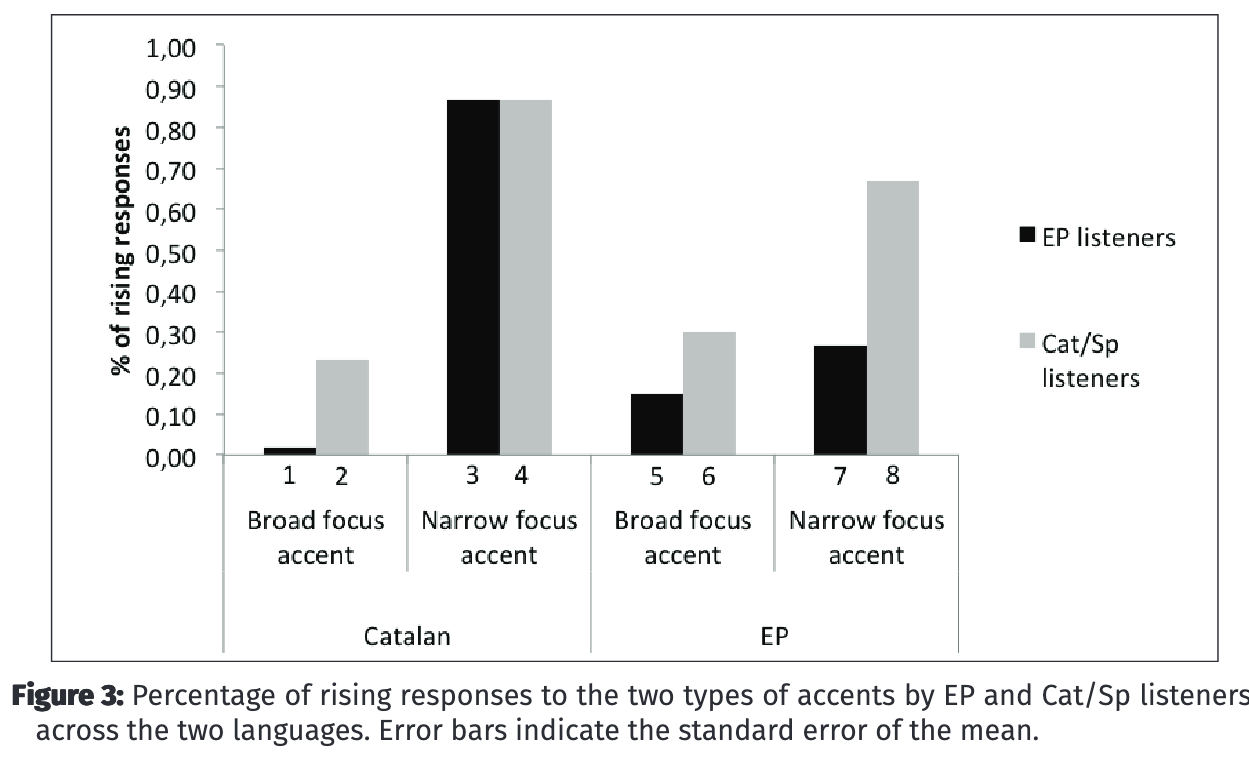
- EP listeners tend to perceive salient fall in EP narrow focus (Bar 7) while Catalan/Spanish speakers tend to perceive salient rise in Catalan narrow focus (Bar 4)
- EP listeners judge EP narrow focus as falling (bar 7) but Catalan narrow focus as rising (bar 3)
- Cat/Sp listeners perceive rises as more salient overall, but still had difference between responses for EP vs. Catalon narrow focus in same direction as EP listeners (bars 4 vs. 8)
- Broad focus peaks tended to be judged as falling across languages/listeners (bars 1/5 for EP listeners, 2/6 for Cat/Sp listeners)
Similar phonetic realization, same phonological category: vocative chant/calling contour
In all the languages discussed here it seems clear that we are dealing with the same tune – again allowing for the conceptual difficulties with the notion of ‘the same tune’. It also seems clear that the tune is associated with texts in ways that differ systematically between languages. A comparative study of intonation would obviously be incomplete if it failed to note the striking similarity of the calling contours across the languages of Europe; it may well be – as has often been suggested (e.g. Abe 1962) – that these similarities can be accounted for by functional principles such as the need to sustain high pitch to ensure audibility in calling at a distance. But the comparative study would be equally incomplete if it failed to note the differences of detail between languages. In the present case, the most significant differences of detail are the ‘phonotactic’ ones discussed in this section – differences that the AM framework makes it straightforward to describe.” (Ladd, 2008, p. 119)
- Based on Ladd (2008), Section 3.2.3.1, p. 116-119:
Language |
Tune |
Notes |
| English |
(L) H* !H |
First H associated with primary stress |
| German |
(L) H* !H |
First H associated with primary stress |
| Hungarian |
(L) H* !H |
H...!H sequence on last two syllables |
| French |
(L) H* !H |
H...!H sequence on last two syllables |
| Dutch |
(L) H* !H (!H) |
German-like, but can have two downsteps in a row |
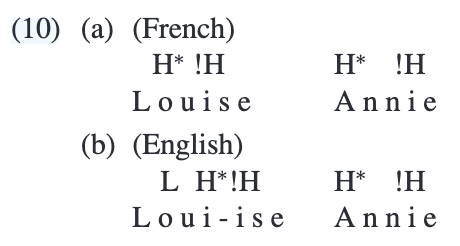
As observed in Ladd (2008), the final pitch in the vocative chant contour has been offered many different analyses, namely HL% (MAE_ToBI; Beckman et al., 2005), absence of boundary tone (ToDI; Gussenhoven, 2005), or !H% (GToBI; Grice, Baumann, & Benzmuller, 2005). For the Romance languages under consideration, the alternative analyses that have been proposed are !H% and M% (e.g., Frota, 2014, for Portuguese; Prieto, 2014, for Catalan; Prieto & Roseano, 2010, for Spanish). Importantly, the phonetics of the sustained boundary tone is strikingly similar in these languages: the somewhat lower pitch after the accentual peak stays level until the boundary, and the spreading of the sustained pitch goes together with the lengthening of the syllable(s) in the post-tonic stretch.” (Frota, 2016, p. 8)
- Could we capture the generalization of the sustained fall tune, but differences in association using something like the representation proposed in Torreira and Grice (2018)? Recall...
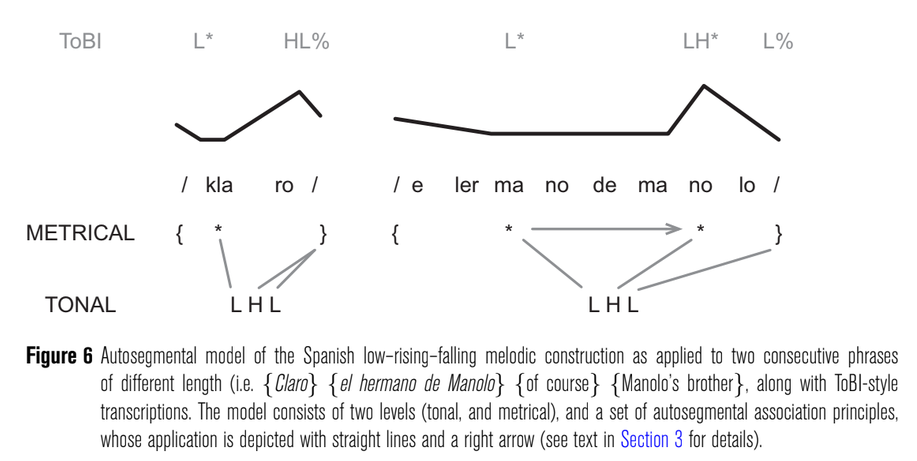
- Why go with a uniform transcription, like in Frota and Prieto (2015) across Catalan/Spanish/Portuguese?
- Same function (and contrasts with a falling calling contour)
- Not clear there are language-internal reasons to argue for one analysis over the other
- Same phonetic realizaton of sustained, lower pitch in post-tonic material
Different phonetic realizations, but some differences not contrastive: EP nuclear falls
- Early peak (H+L*) for broad focus/topic reading vs. late peak fall (H*+L) for narrow/contrastive focus
- But also predictable, allophonic, "domain-limit" effects on alignment
- Later alingment of early peak fall right after IP boundary (at beggining of topic phrase)
- Earlier alignment of late peak fall when final in IP and preceded by prenuclear accents (reminiscent of discussion of Hualde's analysis of Spanish fall last week)
Different phonetic realizations, differences can be contrastive: Majorcan Catalan vs. EP nuclear falls
- Variation in scaling of f0 peak in EP nuclear falls for broad vs. narrow focus is not perceptually distinctive
- But variation in scaling of f0 peak in Majorcan Catalan falls conveys difference between higher, upstepped information-seeking (ꜟH+L* L%) and lower confirmation-seeking questions (H+L*)
...only in the latter case do surface peak height differences correspond to true structural differences.” (Frota, 2016, p. 13)
- Remaining unresolved issue: are we talking about semantic/pragmatic "meaning" contrast and/or phonological "form" contrast?