Write up French tonotactic grammar.
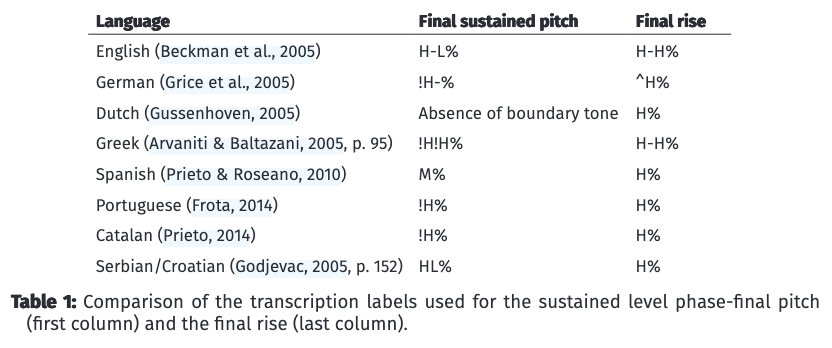
“From the start of the development of the system, it was made clear that ToBI was not an International Phonetic Alphabet for prosody, and since intonation and prosodic organization differ from language to language (and even from dialect to dialect within a language), the ToBI system developed for a given language variety cannot be directly used for another language variety (see Jun, 2005, p. 2). In our view, one of the reasons for the present difficulties in cross-linguistic comparison is precisely the lack of a definition within the ToBI framework of a set of universally accepted transcription units that researchers can use. Thus, in Jun (2014) tonal patterns for each language are described by taking the ToBI inventory used for each language directly, which takes for granted a high degree of comparability across labels. However, since the ToBI labels represent abstract phonological units, they might not be comparable at the surface phonetic level. Sometimes, in fact, very different notations have been proposed for what looks like essentially the same pitch contour. A good example is the use of the L+H* vs the H*+L label for the same surface pitch contour, the much discussed on-ramp and off-ramp analyses (Gussenhoven, 2004; Ladd, 2008a, p. 99). Other times the same label is used for phonetically rather different contours, a fact to which we will return below.” (Hualde and Prieto, 2016, p. 4)
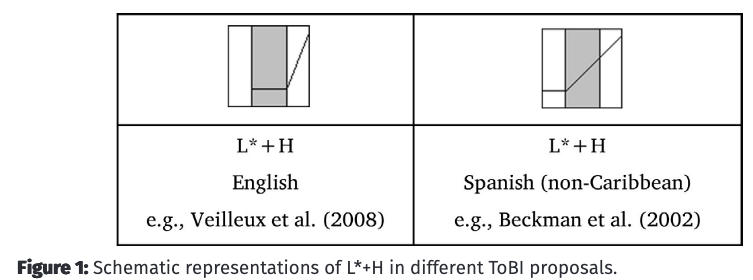
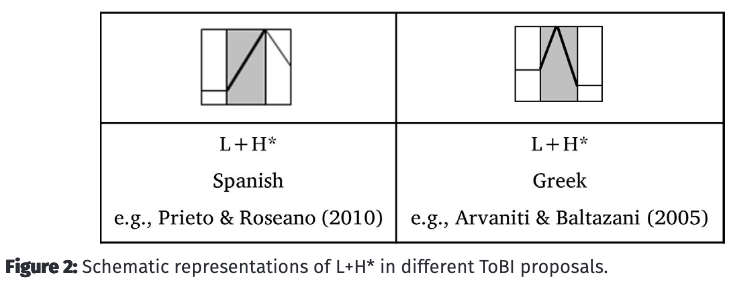
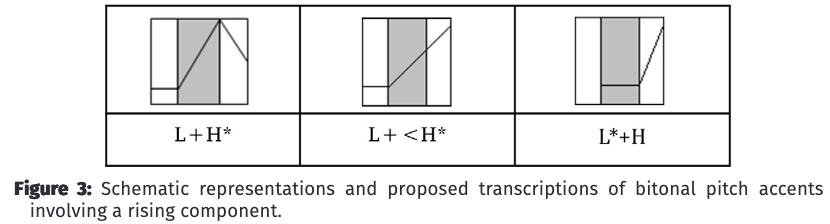
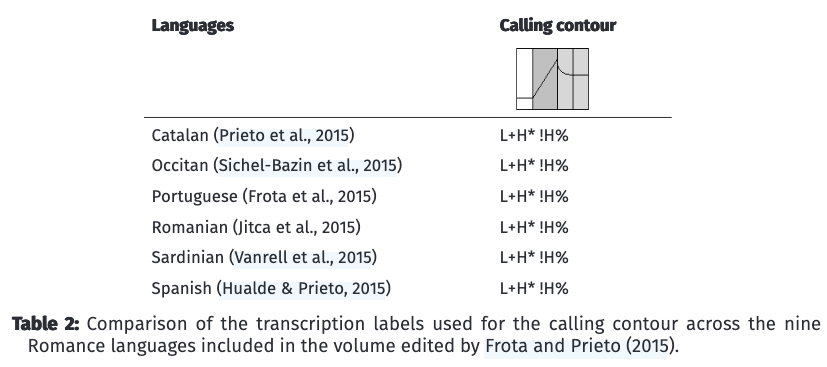
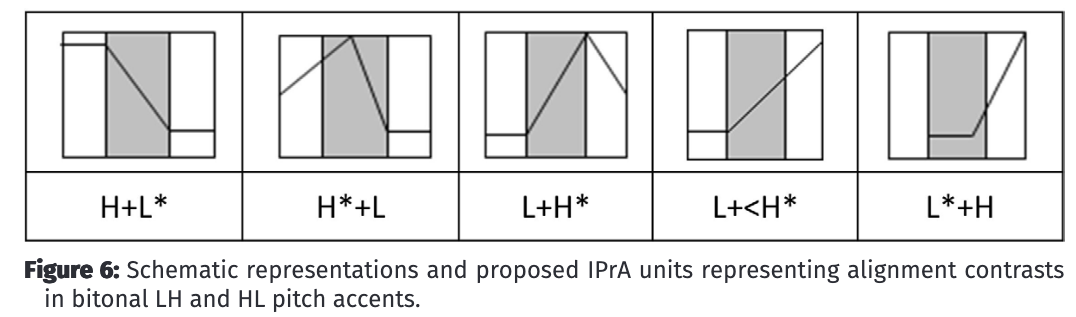
Phonological level could help with confusion in variation in phonetic realization due to truncation, compression; phrase-initial L+H* which may not show L target, etc.
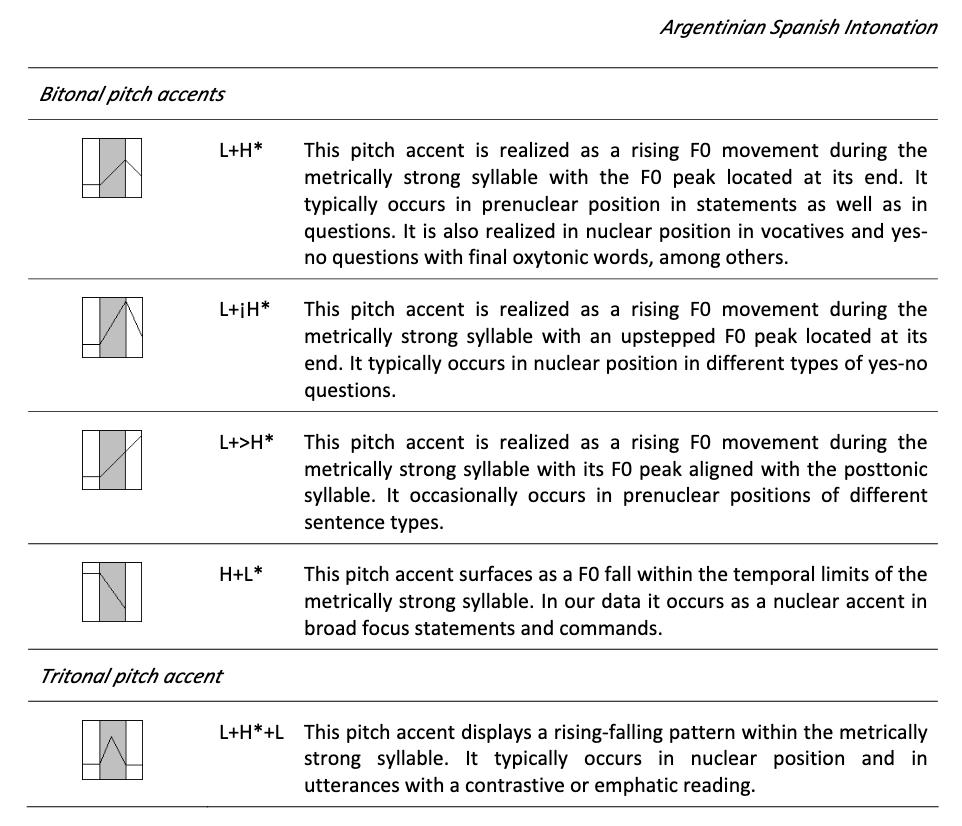
Proposed IPrA broad phonetic transcription labels example for bitonal accents
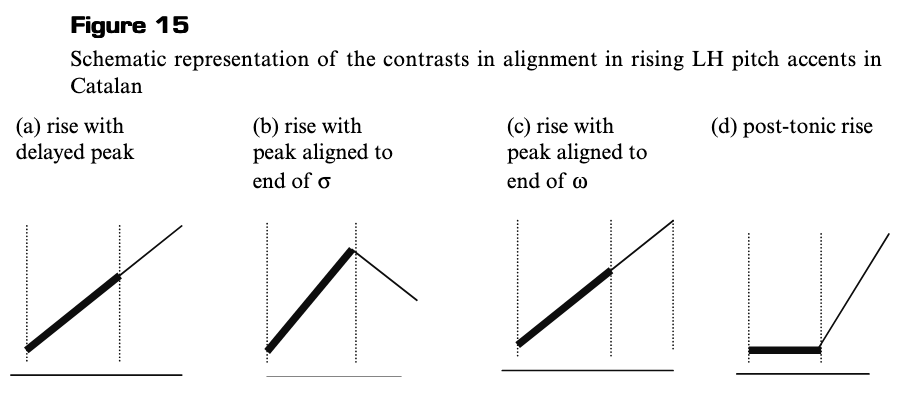
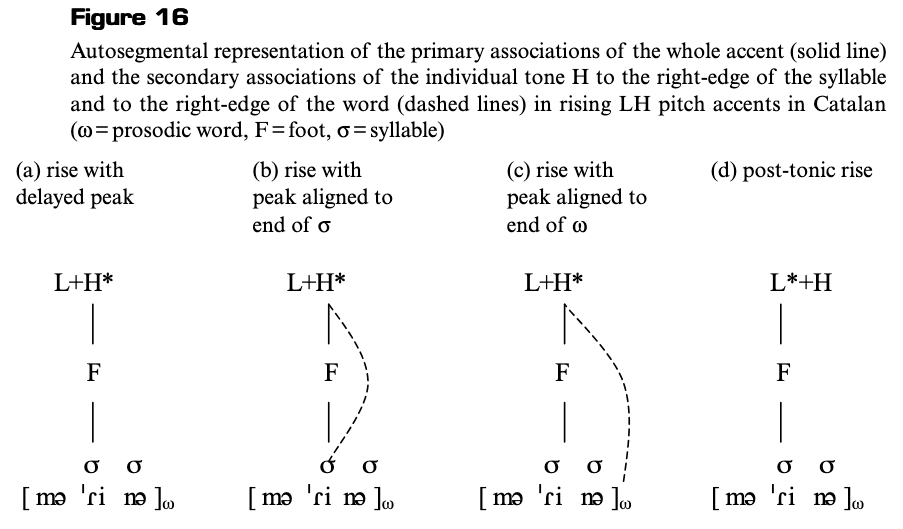
a three-way alignment contrast can be found in prenuclear position in Catalan, as follows: (i) a rise with a delayed peak is found in prenuclear accents in statements; (ii) a rise with a peak aligned with the end of the syllable is found in prenuclear accents in imperative sentences; (iii) a posttonic rise is found in prenuclear accents in yes-no questions.” (Prieto et al., 2005, p. 371)
Idea for Pisa Italian:
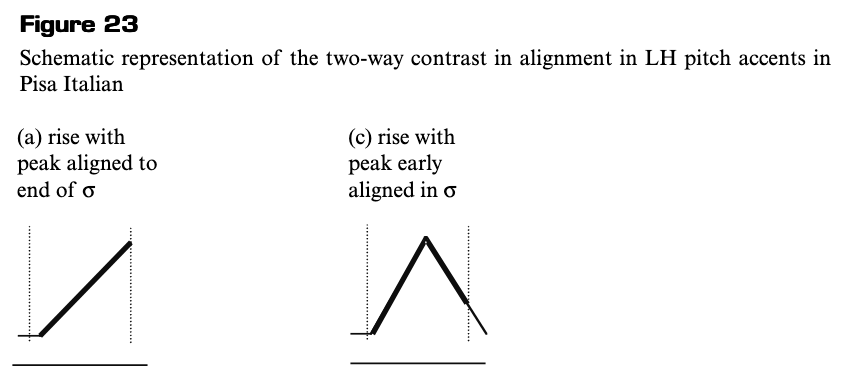
Prieto et al. (2005) also includes a tritonal accent proposal for Pisa Italian, for an accent that has an early peak and low trailing tone in narrow focus (see Figures 23, 24 below)
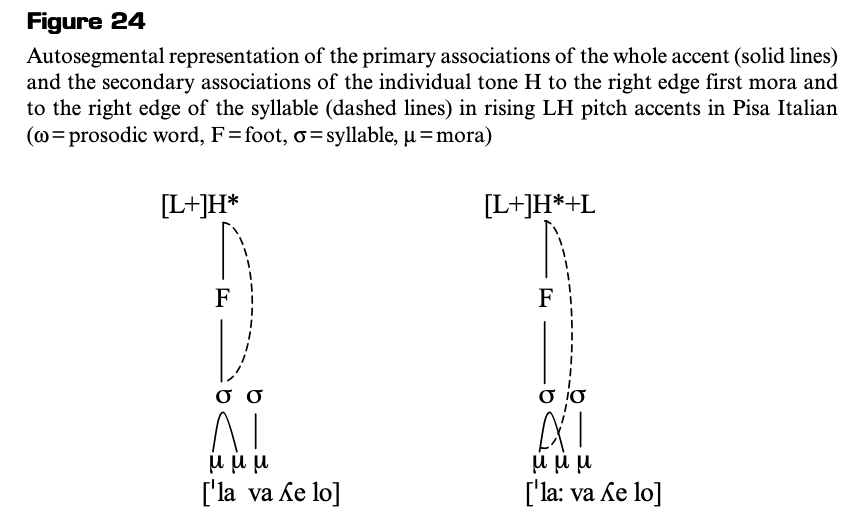
the shape of some porteño accents requires the introduction of such a tritonal unit, involving two low (L) tonal targets besides a H* target in order to account for the fact that the contour rises and falls within the limits of the metrically strong syllable. (p. 288)