_W3_readings_README Google doc in the readings/w3 subdirectory for my notes on your comments. This also explains some added readings I put into the folder.Selkirk (1981, p. 388) On the nature of phonological representation provides one of the early statements of the foundational idea of indirect reference (boldface mine):
A last claim that I wish to make is that phonological rules are sensitive to prosodic structure, but not to syntactic structure. This would follow if, as has been suggested, syntactic structure does not form part of phonological representation. What this means is that phonetic effects such as rhythm, or final lengthening, or the realization of intonation contours, cannot be seen as depending directly on syntactic structure (contrary to what many scholars, such as Cooper (1975) or Klatt (1975) have assumed). Rather, in this theory, prosodic structure mediates between syntax and phonetic realization, and it is in terms of it that all aspects of phonetic interpretation are to be explained.
Note that the existence of non-isorphisms, or mismatches, between syntactic and prosodic structure are the key motivation for the hypothesis of indirect reference. The idea of Match Theory is a total departure from centering on mismatches: instead, the key idea is that prosodic structure is (mostly) "faithful" to syntactic structure---mismatches are an exception.
A thorough review of indirect and direct reference theories is Elordieta (2008) which is in the folder. This also talks a bit about phrase-related theories, which has been another major class of responses to mismatches and/or challenges to assumptions of clustering, containment in Prosodic Hierarchy Theory. Pak (2008) in the folder is an example of phase-based approaches.
One important thing to remember is that both indirect and direct reference theories assume there is no access to syntactic category labels (although the distinction between clauses and phrases is always tricky to think about if that's the case)
People often cite Selkirk (1984, p. 26) for the SLH, which is the book Phonology and Syntax:1
In previous work, we have assumed that a fairly rich hierarchy of prosodic constituents or prosodic categories forms part of phonological representation (see, for example, Selkirk 1978c, 1980a,b, 1981a). We have suggested that the hierarchy for English includes at least the following categories:
(1.10)
intonational phrase (IP)
phonological phrase (PhP)
prosodic word (Wd)
foot (Ft)
syllable (Syl)We have proposed that a category of level i in the hierarchy immediately dominates a (sequence of) categories of level i-1 (Selkirk 1981a). (Assuming syllable to be level 1, the others will be levels 2, ..., n.) We will call this the strict layer hypothesis, and will take it as a useful working hypothesis here.
For good measure, I also dug up the Selkirk (1981a) referred to (also added to folder, On the nature of phonological representation), and it states (p. 382)
The combinatorial possibilities of prosodic categories are far more restricted than those of syntactic categories. Suppose the prosodic categories were identified with integers, with 7 being assigned to the segment, 2 to the syllable, 3 to the stress foot, 4 to the prosodic word, 5 tothe phonological phrase, 6 to the intonational phrase and 7 to the utterance. In general, it is true that a prosodic category of level n is defined as consisting of categories of level n-1.”
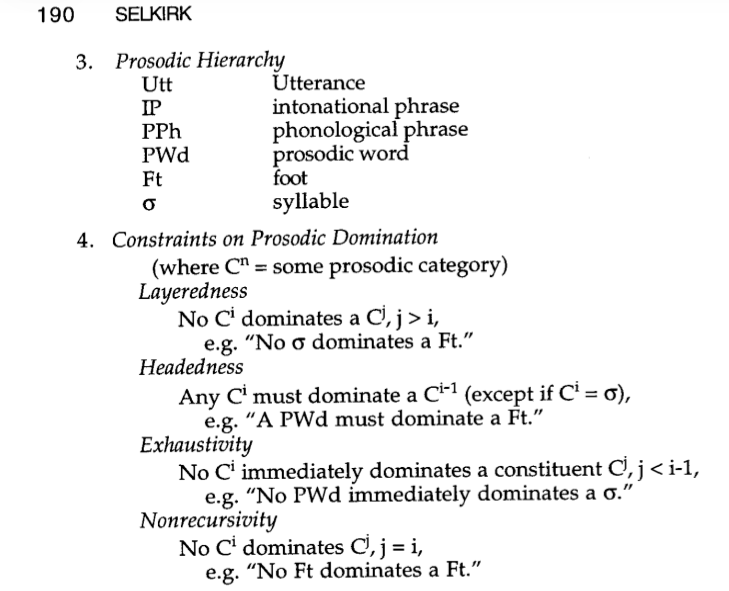
Decompositions of the SLH occur in Nespor and Vogel (1986) and Selkirk (1996). Selkirk (1996) introduces a set of prosodic markedness constraints that are widely used in work on prosodic structure---screenshot below. Generally I would say that people are fairly happy to violate Exhaustivity and Nonrecursivity in their analyses (although note that in Alessa's Tagalog syntax-prosody analysis, avoidance of an Exhaustivity violation was crucial for motivating the syntax-prosody mapping observed.)
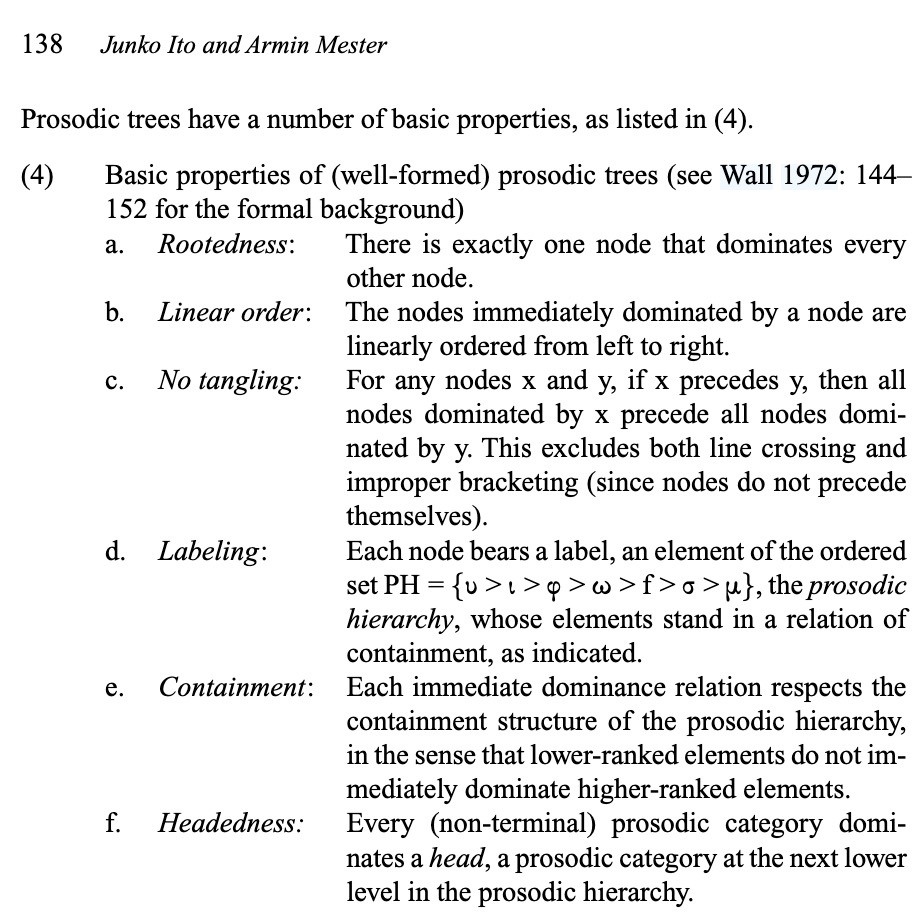
This book actually went in another direction than Selkirk (1978/1981) and abandoned some of the prosodic constituents originally proposed! ↩