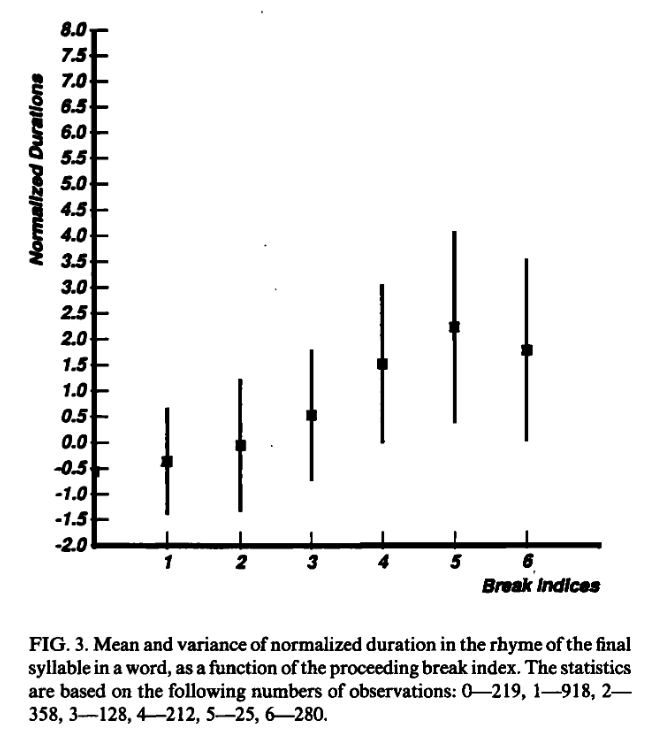
What is pre-boundary lengthening?
"Preboundary lengthening" describes the tendency for segments prior to a prosodic boundary to be longer than they would be in other contexts, and references to this phenomenon are ubiquitous in the literature. (Wightman et al. 1992, p. 1710)
Price et al. (1991) decided on transcribing 7 levels for perceptual labels of grouping agreed upon by 3 labellers, why?
0 boundary within a clitic group 1 normal word boundary 2 boundary marking a minor grouping of words 3 intermediate phrase boundary 4 intonational phrase boundary 5 boundary marking a grouping of intonational phrases 6 sentence boundary
Break indices of 4, 5, and 6 are "major" prosodic boundaries; constituents defined by these boundaries are often referred to as "intonation phrases". (Price et al. 1991, p. 2962)
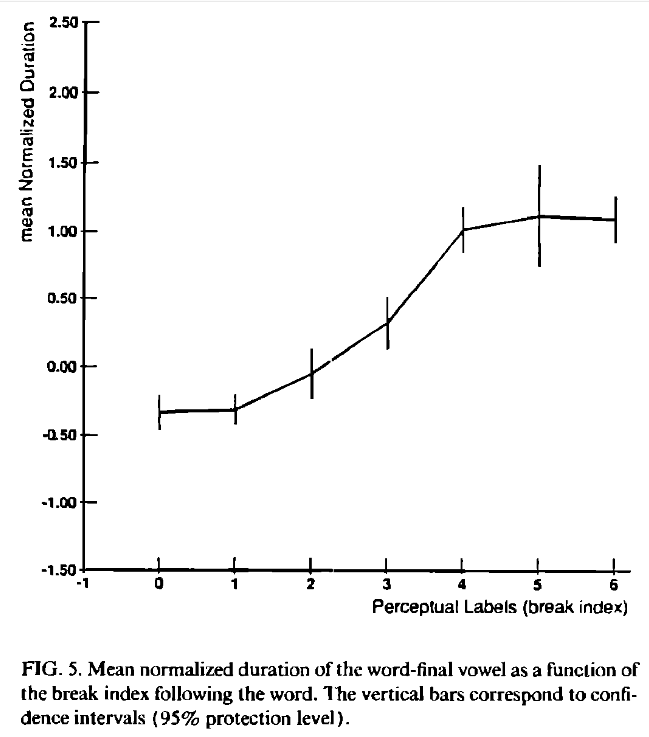
Two opposing camps: small finite number of categorically different prosodic boundaries (like Intonational Phrase, intermediate phrase) vs. gradiently varying boundaries
Example stimuli:
Perceptual task: visual analogue scale with slider bar.
“You will hear a number of sentences. In each sentence, the word donut will appear. Please judge how strongly connected the word donut is with the word following it. You can listen to the sentences two times. When you have decided, give your answer by clicking on the bar on the screen.”
Gaussian Mixture Models fit to production data to see how many clusters gives best fit to data: 2 clusters.
k-means clustering of VAS scores for 2-8 clusters: not much difference in distance and overlap between 3-8 clusters.
From Beckman et al. (2005) in the Prosodic Typology I volume:
First, history building up to BIs:
The treatment of juncture in Price et al. (1991) also has a long history. Essentially, it uni®es earlier phonetic work on the relationship between juncture and syntax, and on discourse level effects on duration and pitch range (e.g. Lehiste 1960, 1975; O'Malley et al. 1973; Cooper 1976; Nakatani et al. 1981; Gee and Grosjean 1983), with the treatment of segmental sandhi effects in metrical phonology (e.g. Selkirk 1978; Nespor and Vogel 1986). The further insight achieved by comparing transcriptions at the first Prosodic Transcription Workshop in 1991 was that this treatment of juncture could also be linked to the treatment of intonational phrasing in Beckman and Pierrehumbert (1986) by identifying the perception of juncture at break index levels 3 and 4 as being cued in part by intonation contour shapes at the edges of Beckman and Pierrehumbert's (1986) intermediate phrase and intonational phrase, respectively. We also agreed that any perceived variation in boundary strength above the intonational phrase (BI 4) could not be identified with the domains of prosodic effects such as the distribution of phrase tones, and therefore, that 'utterance' and `paragraph' ends should not be marked (see Section 2.4). The transcription of tones following Beckman and Pierrehumbert (1986) and Ladd (1983) thus provides the Tones part of MAE_ToBI, and the transcription of perceived juncture at the ends of prosodic units in Price et al. (1991) provides the Break Indices part.
On how MAE ToBI ended up with 4 BI labels:
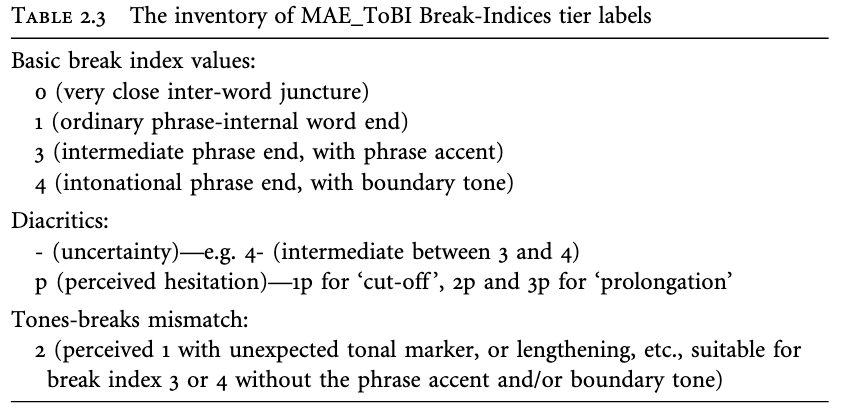
The four* basic Break-Index values and the several diacritics and other labels for phenomena such as a marked prolongation that disrupts the intonation contour are given in Table 2.3.
*Note that there are only four basic break index values, ordered from 0 to 4, with a 'hole' at 2. In the original Price et al. (1991) use of break indices, the value 2 represented a perceived boundary strength intermediate between a normal word boundary and a larger phrase boundary, and was used to mark a number of imprecisely-defined phenomena. The ToBI system restricts the use of this label to an explicit subset of these phenomena--namely, inter-word junctures where there is ambiguity between a 1 and a 3 either because there is a phrase tone without the duration lengthening appropriate to a 3, or a lengthening appropriate to a 3 but no phrase tone. This means that ToBI labels do not recognize a prosodic constituent comparable to Selkirk's (1995) 'Major Phrase' unless this is equated with Beckman and Pierrehumbert's (1986) tonally marked 'intermediate phrase'. Labellers who postulate and perceive a constituent boundary that is larger than a 'Prosodic Word' but smaller than the lowest intonationally marked constituent are encouraged to mark these events in a comments tier
There was a strong feeling among a sizeable group at the first workshop that the grouping of intonational phrases into 'utterances' and 'paragraphs' is qualitatively different from the grouping of morphemes into 'prosodic words' dominated by intermediate phrases, and into intermediate phrases dominated by intonational phrases. (Beckman et al., 2005, p. 16)
...Therefore, we decided not to label degrees of perceived disjuncture above the intonational phrase, so that the break indices could be interpreted as a direct implementation of the non-recursive prosodic hierarchy. (Beckman et al., 2005, p. 17)
Fn 4: This meant omitting break indices 5 and 6 from the Price et al. (1991) model, since these two break index values could not be identified with a categorically marked level of prosodic structure such as the intonational phrase. Rather, they were intended to encode the percept of (possibly recursive) higher-level groupings above the intonational phrase.
From Pierrehumbert (2000), Tonal elements and their alignment:
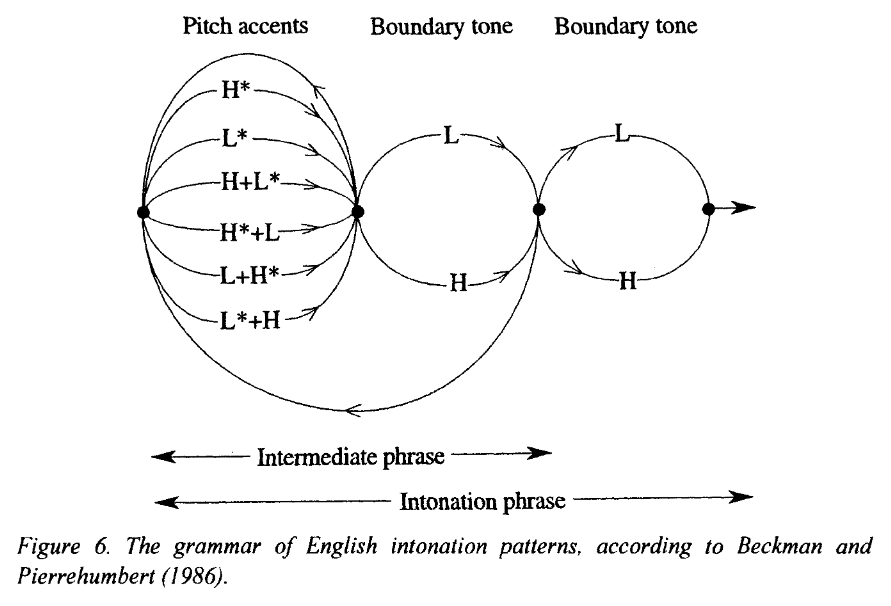
See Jun (2022): clearly not always independent; more often than not BI ends up being redundant if prosodic boundary tones have already been annotated. But remember that not all intonational phonology analyses have obligatory right-edge boundary tones!
Because the BI is tightly linked to the prosodic structure of a language, the number of BI categories will differ across languages, reflecting the number of prosodic units a language has. However, the number of prosodic units defined by a tone does not necessarily match the number of BIs, because a prosodic unit is not necessarily marked by intonation. For example, Cantonese has only one prosodic unit defined by intonation, IP, but its ToBI system has three BI numbers: 2 for an IP boundary, 1 for a foot boundary, and 0 for a foot-internal syllable boundary. Furthermore, the Pan-Mandarin ToBI has six BI numbers, but only one BI (BI 4) corresponds to a prosodic unit defined by pitch reset. (p. 160)
Because some of the BIs do correspond to a tonally defined prosodic unit, labeling both a BI on the BIs tier and a boundary tone on the tones tier would mark the same prosodic unit. For example, in MAE_ToBI, BI 3 and BI 4 are labeled on the BIs tier aligned with a phrase accent and an IP boundary tone, respectively, on the tones tier. This seems to violate the “efficiency” principle of the ToBI system, mentioned at the beginning of section 4.3. Namely, the system has to be efficient and should not transcribe predictable information. So, the researchers of a specific ToBI system could decide not to label BIs that are predictable from other tiers but label only those not predictable such as mismatch cases.” (Jun, 2022, p. 161)
De-emphasis on BI part of ToBI in transcription and phonological analysis
As a tagging tool, the ToBI system can include labels that represent surface tonal patterns, and this makes its level of tonal representation clearly less abstract than that proposed in the AM model of intonational phonology. However, the common practice of using ToBI-style labeling (employing primarily the words and tones tiers) when trying to build a model of intonational phonology of a language seems to have blurred the distinction between the ToBI system and the AM model of intonational phonology. This trend can be observed in publications such as Prieto and Roseano (2010), Jun (2014b), and Frota and Prieto (2015), where most models of intonational phonology and most ToBI transcription systems look quite similar to each other. Consequently, the BI part of ToBI has also become less emphasized in the ToBI system. In fact, it is not uncommon to hear researchers refer to the “ToBI model” of a particular language, which would seem to equate the transcription system with the intonational phonology model of the language.19” (Jun, 2022, p. 169)
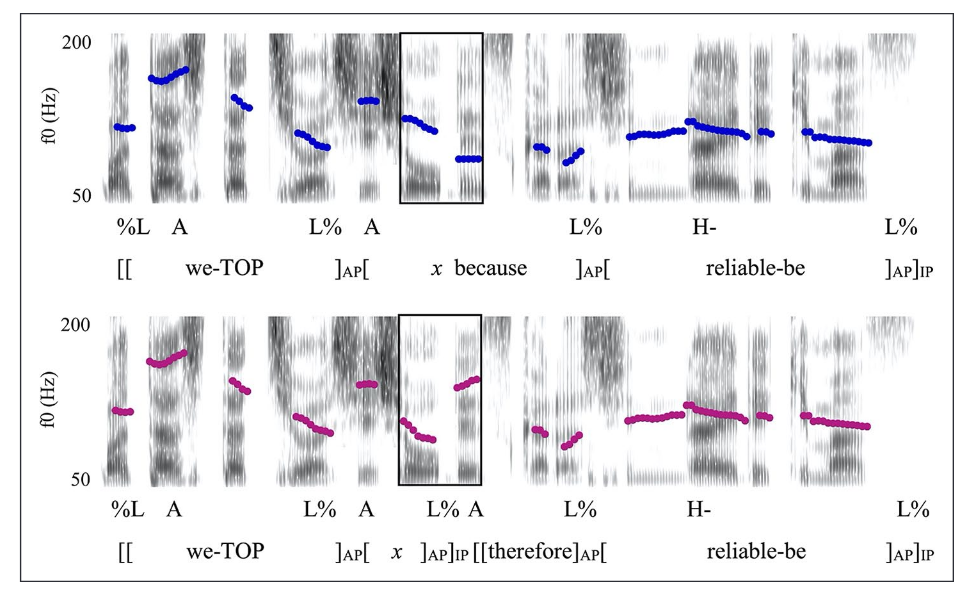
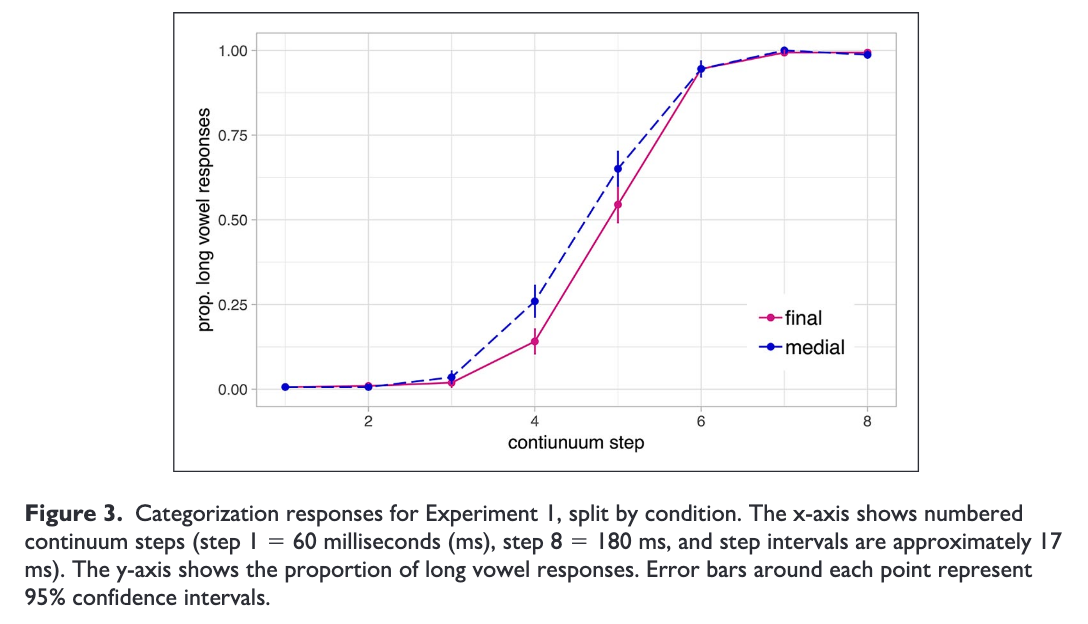
Final Lengthening refers to an increase in segmental duration at the right edge of different types of prosodic domains above the word level (Paschen et al., 2022, p. 1)
We use the term Final Lengthening to refer to any lengthening within a two-syllable window before a boundary” (Paschen et al., 2022, p. 2)
Corpus: 10,000 word sample for each language from DoReCo corpus, 25 mostly understudied languages; 538,719 data points
Position definition (p. 6):
Silent pauses were identified during manual correction of word boundaries before running the final round of forced alignments. The DoReCo team made a great effort to ensure any interval labelled as a silent pause corresponds to some sort of juncture between two prosodic units rather than being just a gap due to consonantal closure. However, as no lower threshold was used for pause length, there will inevitably be some instances where the pause status of an interval could be debated.” (Paschen et al., 2022, p. 6)
Duration normalization: none, but log-transformed, and with random intercepts for segment, interpausal unit, language, and speaker (and some random slopes). To what extent does including random effects play the role of normalization? (See Voeten et al. 2022 on vowels).
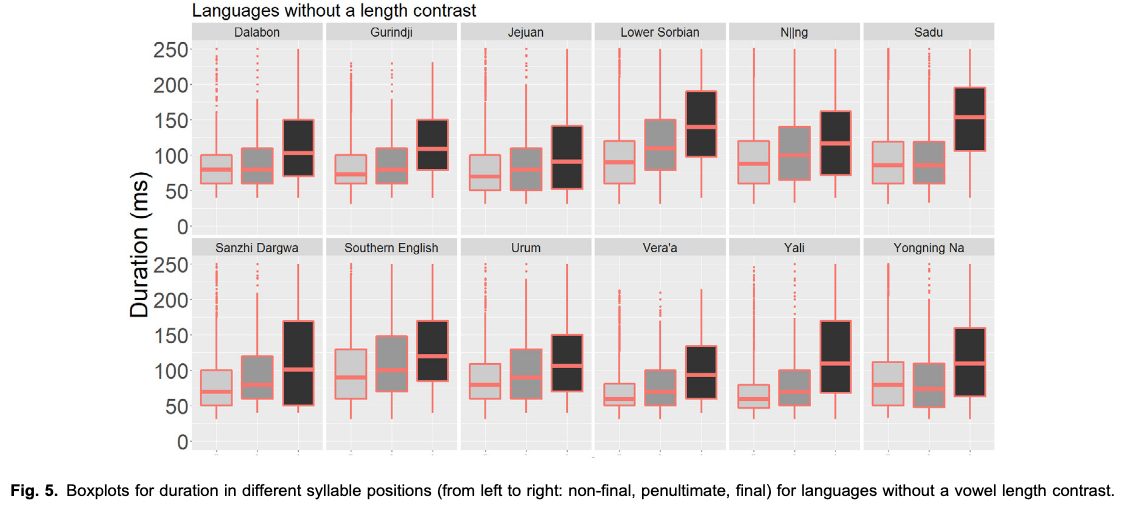
Consistent lengthening in final position, and sometimes also in penultimate position, see Fig 5, position is non-final, penult, final from left to right
Silent intervals between words that were detected by the automatic speech segmentation system (>50 ms) were treated as pauses. We are not aware of any agreed-upon threshold for the duration of phonetic silence that counts as an actual pause. (Kentner et al., 2024, p. 4)
Coding of boundary strength based on punctuation and morphosyntactic features of text from Franz et al. (2022)
Durations: log-transformed, but no normalization; novel and speaker included as random intercepts.
Results: