Types of interactions between word-level tones and "F0 intrusions at the the phrase- or utterance level"
What are intonemes?
It is common knowledge that tone languages can have F0-based intonation, including H and L intonation tones (or 'intonemes') (p. 267)
Table 1 Mazahua examples (from Pike?):
Coreguaje examples: LHL% statement and HL% question intonemes?
However, the question is not whether all languages have utterance-level F0 modulations such as raising vs. lowering of pitch level or expanding vs. compressing of pitch intervals, but rather whether there are languages which lack ‘structural’ intonation, i.e. categorical intonational pitch features or intonemes. (p. 269)
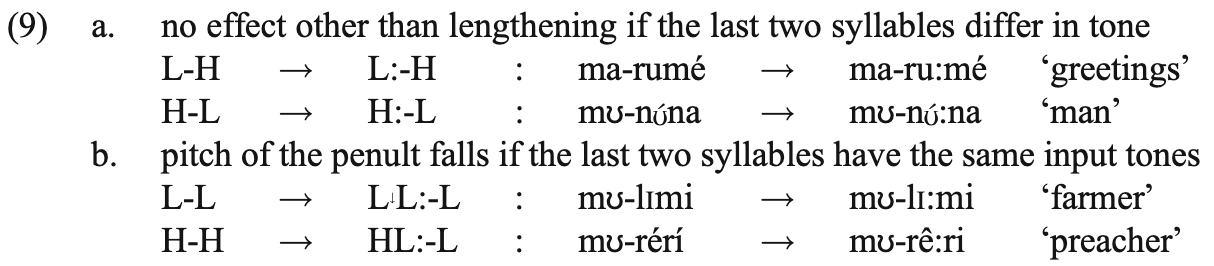
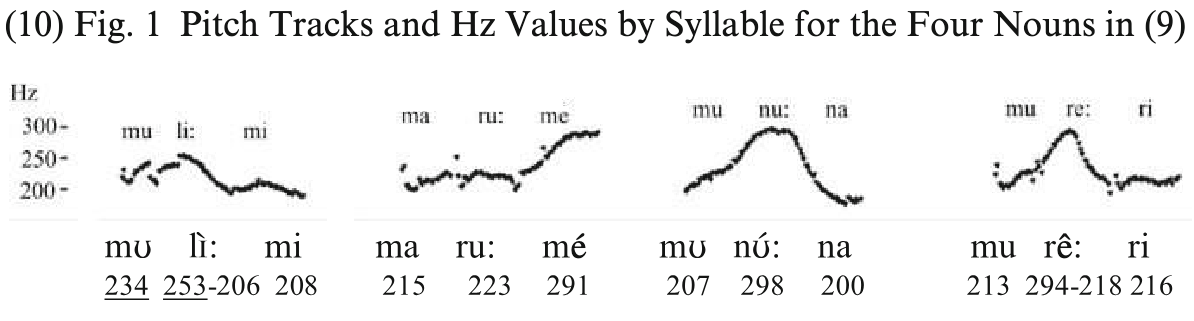
Penultimate lengthening and PLL

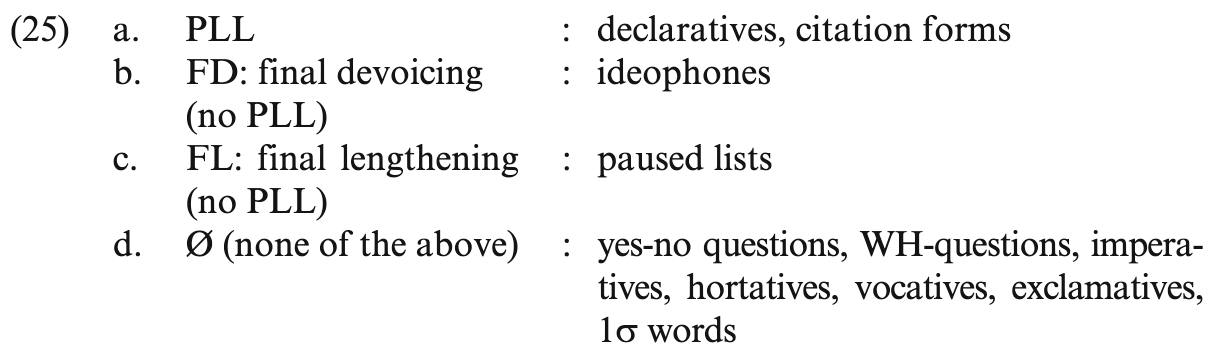
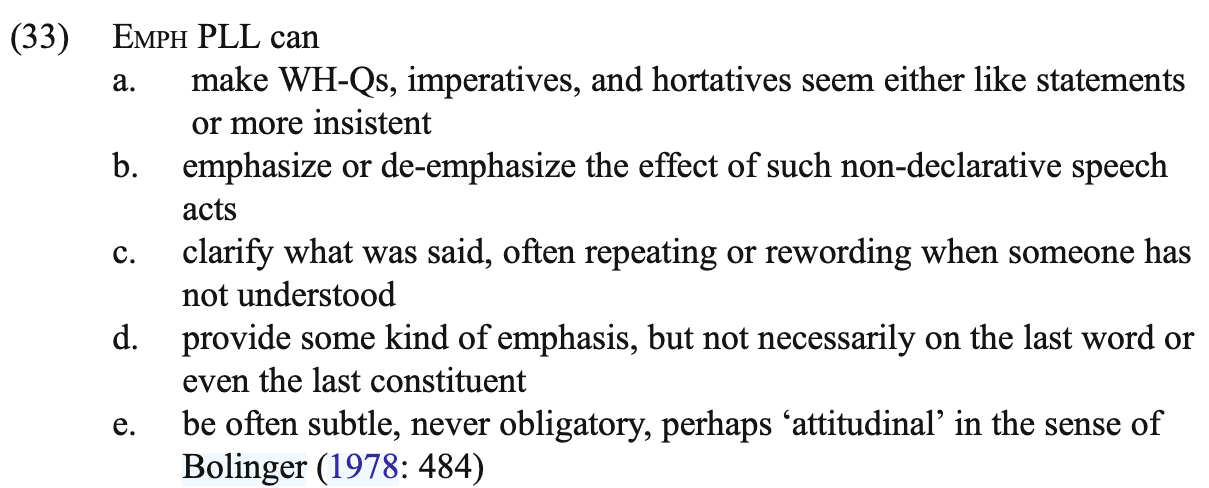
readings/w6): let's take a look at pages 594-595The Shekgalagari system naturally raises the question of what the full range of intonational features is. Besides pitch, length, and devoicing, attested in Shekgalagari, both breathy and creaky phonations as well as the laryngeal segments -h and -ʔ have been claimed to mark intonation. For example, final glottal stop marks imperatives in Lahu (Tibeto-Burman; Thailand, China, Myanmar) (Matisoff 1973: 353), questions in Kaingang (Macro-Ge; Brazil) (Wiesemann 1972, Wetzels 2008), and negatives in Dagbani (Niger-Congo, Gur; Ghana) (Hyman 1989). Perhaps other prosodic features such as nasality may also be exploited for intonation (cf. the ‘nasal pause’ phenomenon in Amazonia (Aikhenvald 1996: 511-512)). Whether suprasegmental segments such as -k, -s, or -m or full syllables can mark intonation has been questioned (Hyman 1989), although Aikhenvald (1998: 410) reports the case of -hi ̃or h + a V copy with nasalization in Warekena (Arawakan; Venezuela): ‘A morpheme -hv ̃ ‘pausal marker’ is inserted at the end of a phonological word or a phonological phrase.’ We have cited Matisoff’s (1994: 118) comment about the equivalence of particles to intonation marking, a point also taken up by Ladd (1996) and in earlier work of my own: ‘. . .besides the parallel in function, there may be important structural similarities between boundary tones and particles. In fact, the difference may be simply that the former lack segmental content, while the latter do not’ (Hyman 1990: 123). Thus, paralleling intonational marking in other languages, ‘interrogative, exclamatory, imperative, emphatic, and doubt meanings in Capanahua are represented in the base component by features that are spelled out as segments (morphemes)’ (Loos 1969: 211). (Cf. paralinguistic [+irritation] marking in Capanahua: ‘Anger and irritation are not given morphemic shape in the string, but are expressed... by nasalization of the whole sentence’.) This raises the question of whether prosodic ‘intonemes’ are morphemes (Hyman 1990), and if so, whether they should be identified as clitics or phrasal affixes in the sense of Anderson (1992, Chap. 8). (p. 285)
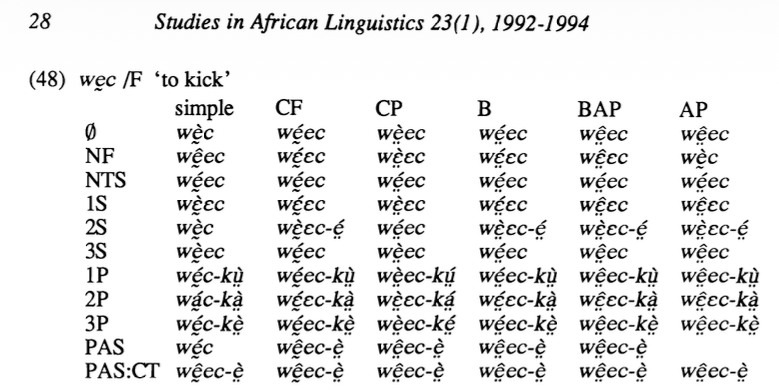
readings/w6/ from Andersen and DimmendaalParadigm from Andersen (1995) for 'kick':
From Dimmendaal 2014 handout on Dinka: diachronically, features on concatenated suffixes/enclitics became tone/voice quality/length contrasts on lexical roots
Grammatical suffix/enclitic |
Proto-Nilotic |
Floating features as reflexes in Dinka roots |
|---|---|---|
| Ventive (ATR harmony: dominant) | *-u | vowel change (breathiness), tonal change |
| Itive (recessive) | *-ta | tonal change |
| Dative (vowel harmony: dominant) | *-ki | breathiness, tonal change |
| Singulative number suffixes | *-at; *-ɪt, -*-it | vowel change, tonal change |
| Nominative case | *-ɪ / *-i | tone |
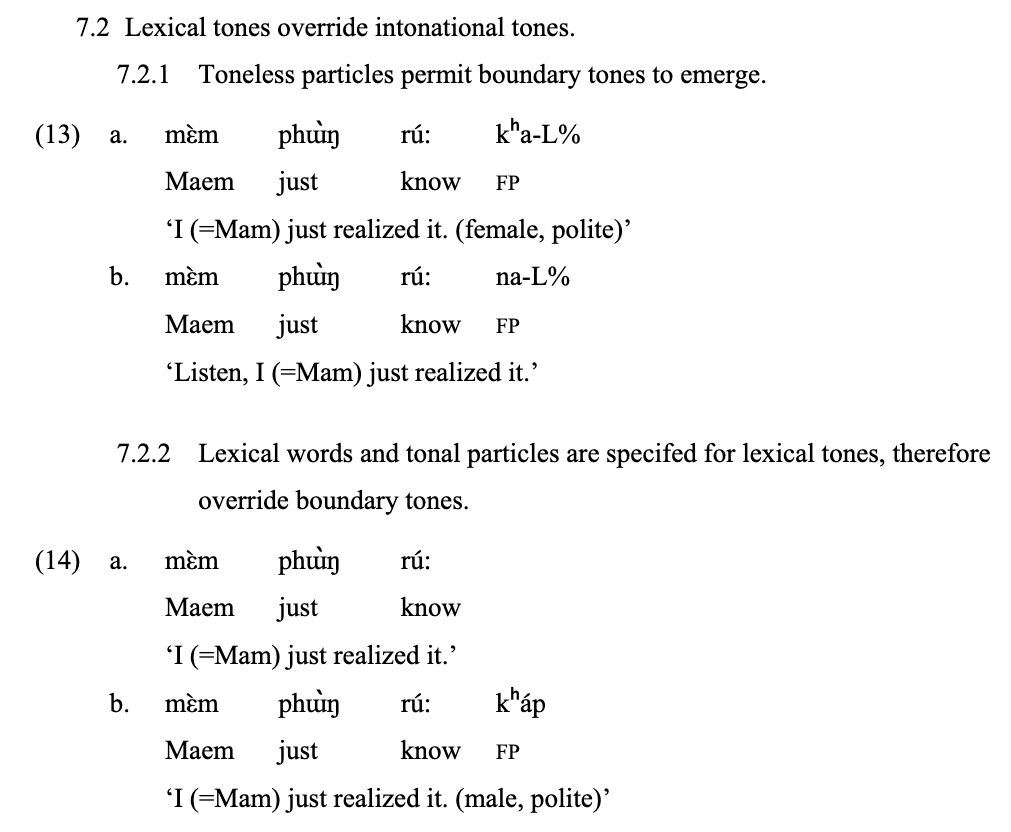
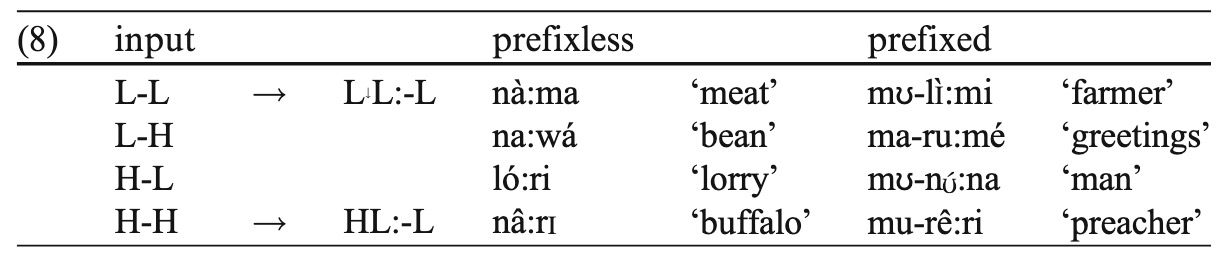
readings/w6) on tonal vs. toneless final particles in Thai (from Workshop on “Intonational Phonology: Understudied or Fieldwork Languages” August 5, 2007)